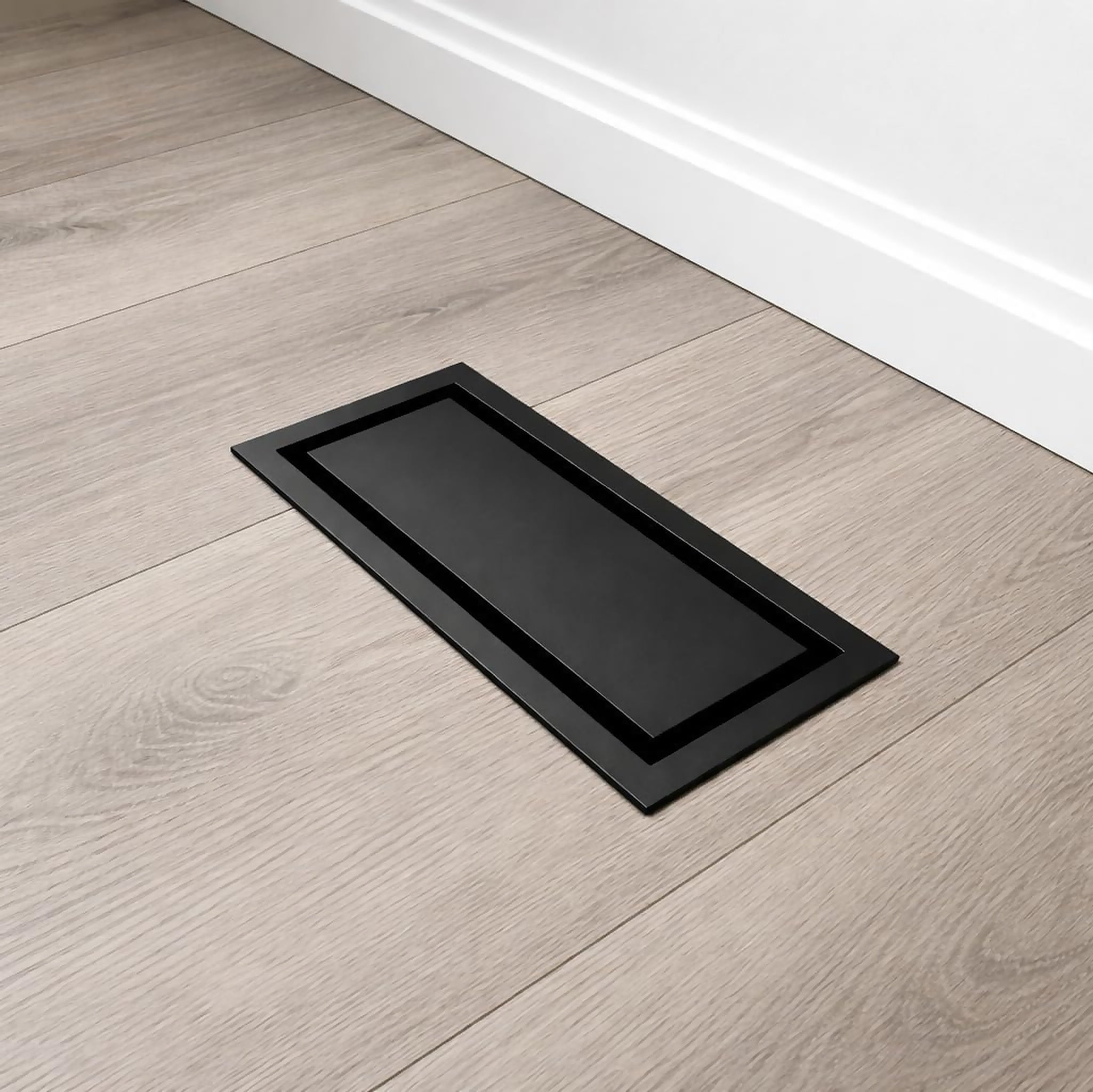
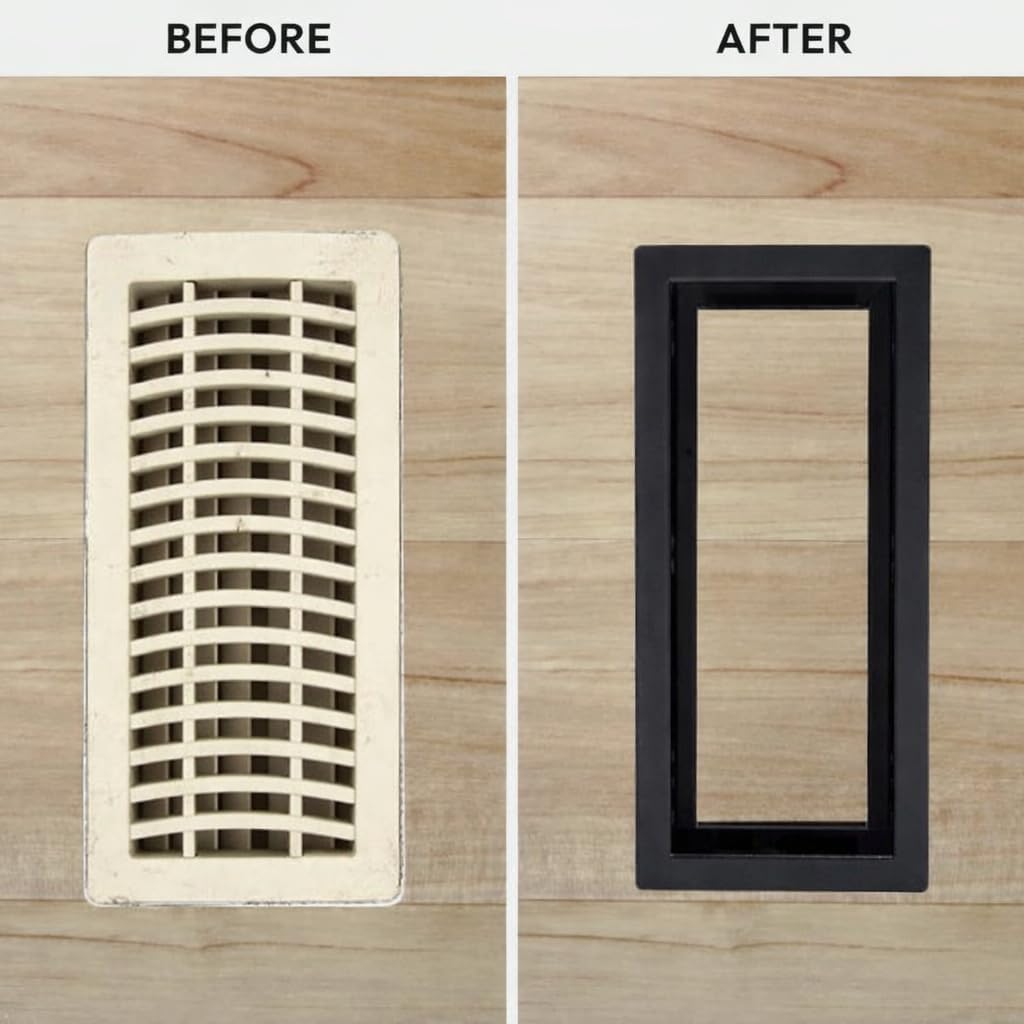
If you are wondering whether flush floor vents restrict airflow, you have probably already heard the warning: "Don't do it, they restrict airflow and will ruin your HVAC system." As the owner of Khan Supply CO, I hear this fear all the time. So I stopped guessing and measured it in my own house. Here are the numbers, and what they mean for the vent you should actually buy.
Before getting into my own results, it helps to ground this in how a typical North American forced-air system behaves. Your furnace or air handler blower is basically trying to move a certain amount of air (CFM) through a network of ducts, turns, filters, coils, and grilles. Anything that adds resistance increases the system's static pressure.
If you have a modern variable-speed (ECM) blower, it will actually ramp up its electrical draw (working harder) to push past that resistance and maintain airflow. The important part is this: a register face is only one of many "resistance points" in your home, and it is almost never the biggest one.
Now for the candid part: I know I sell flush, floor-matching vents at Khan Supply CO, so I might sound biased. But the reason I am comfortable saying the fear is usually overblown is simple — I tested it in my own house, and my home has always used (and will keep using) flush vents because that is the look I want.
The Worry: "The Opening Looks Smaller, So Airflow Must Get Worse"
It is a reasonable gut reaction. A standard plastic register has a fairly open grille, and many flush designs visually look "tighter" because they are trying to disappear into the floor.
But what matters in real life is not what your eye thinks is open. It is:
- Free area: How much of the face is actually open to air.
- Geometry: How the air turns and exits, which can create more or less pressure drop.
- Scale: Whether you changed just a few vents or all of them.
- System health: How close your system already is to its limits (dirty filters, blocked returns, undersized ducts, and so on).
The Real-World Test in My House
- House: roughly 6,000 sq ft
- Vents: 22 Khan Supply CO Undermount Flush Floor Vents, all 4x10
Instead of guessing, I brought in an HVAC professional and treated it like a mini before/after experiment. The goal was not to chase perfect lab-grade numbers — it was to see whether the change was big enough to matter in the real world. We measured Total External Static Pressure (TESP), blower electrical draw (watts), delivered airflow (CFM) at a representative sample of vents, and noise levels.
Here are the best-faith numbers comparing standard registers to flush vents:
| Measurement | Standard Registers | Khan Supply CO Flush Vents | The Difference |
| TESP (static pressure) | ~0.47 in. w.c. | ~0.49 in. w.c. | +0.02 in. w.c. (negligible) |
| Blower draw | ~690 W | ~705 W | +15 W (slight ramp up) |
| Average airflow | ~92 CFM / vent | ~90 CFM / vent | -2% (imperceptible) |
| Noise level | Baseline | Unchanged | No new whistles or hissing |
Comfort and room-to-room balance felt exactly the same. That is the key takeaway: in this house, on this system, switching to flush vents produced changes small enough to be lost in normal day-to-day variability. So I kept them, and I am still keeping them.
What Actually Makes a System Feel (and Measure) Worse
Here is the part most people miss: the biggest "airflow hits" usually come from restrictions that affect the entire system, not just the air exiting one register.
1. High-Resistance Filters
When you install a high-resistance filter, or a thick one your system does not have enough filter area for, you are adding restriction to every single cubic foot of air the blower tries to move. In my house, this was immediately more noticeable than the vent swap. TESP jumped meaningfully (roughly 0.58–0.62 in. w.c.), blower watts climbed to ~740–780 W, airflow felt weaker, and rooms took longer to recover.
2. A Dirty Filter
Same problem, but worse. As the filter loads up, the pressure drop rises. The system becomes "starved," and you feel it: weaker throw, more imbalance, and sometimes more noise at the returns. This can push static pressure into the ~0.65+ in. w.c. range, and the comfort degradation becomes obvious.
3. Closing Supply Vents
Closing roughly six supplies is basically like adding dampers in random spots. It reduces total outlet area and forces air to reroute through what is left. Static pressure rises, air redistributes unevenly, and noise can increase at the remaining open registers. This produced a much clearer "something changed" effect than swapping register styles. If you are not sure which of your registers are supplies in the first place, our guide on choosing between supply and return registers walks through how to tell them apart before you order.
4. Blocking Vents With Furniture
This behaves like half-closing several vents at once. Even if the register itself is open, if the air cannot throw into the room you are effectively throttling delivery and disrupting air mixing. It creates hot and cold pockets that make it feel like the HVAC got worse, when really the room just is not being supplied properly.
5. Blocking Large Returns (The Biggest Offender)
Returns are the blower's intake. Restricting return air is one of the fastest ways to make a whole system feel awful. You get higher suction noise at the remaining returns, higher system static pressure, and lower airflow everywhere. In restricted-return scenarios it is not unusual to see static pressure climb into the ~0.60–0.70 in. w.c. range, and you will feel it right away.
Bottom Line: Flush Vents Are Not the Villain, System Restriction Is
Flush vents can matter if you choose a poorly manufactured design that severely reduces free area, especially if your system is already marginal. That is exactly why we design our vents at Khan Supply CO to maximise free area, giving you that seamless, high-end look without suffocating your system. Every cover is 100% metal, so it will not warp, melt, or discolour the way a plastic register does, and it is backed by a two-year warranty.
If your system is healthy and your returns and filters are not strangling the blower, the impact of switching to high-quality flush vents can be surprisingly small — exactly what I saw in my own home.
Which Khan Supply CO Vent Should You Choose?
Airflow is rarely the deciding factor. The real decision is how flush you want the cover to sit and how much subfloor work you are willing to do:
- Maximum airflow, no subfloor work: our best-selling Drop-In Floor Vent (from $29.69 CAD) uses a click-in compression fit and delivers up to 60% more airflow than comparable flush vents. It drops straight into your existing duct opening.
- Completely flush, built-in look: the Undermount Flush Floor Vent (from $54.99 CAD, in 3x10, 4x10 and 4x12) installs into the subfloor so the cover sits dead level with your flooring. Best decided before your floors go down.
- Still deciding: browse the full flush floor vent collection to compare styles and sizes side by side.
For a fuller breakdown of the two mounting styles, read our comparison of drop-in versus undermount flush floor vents. And before you order anything, measure the duct opening rather than the old cover — our guide on how to measure floor vents for the right size fit covers the exact method.
A Simple Checklist for the Flush Look Without the Fear
- Keep returns clear. This is always the first priority.
- Do not use registers as your main zoning strategy. Avoid closing a bunch of vents to redirect air.
- Choose filtration your system can actually breathe through, or increase your filter area if you want higher filtration.
- Maintain the basics. Change your filter on schedule and keep vents unobstructed by rugs and furniture.
If you want hard proof for your own home, ask an HVAC tech to measure your TESP before and after a vent swap. That one number will tell you everything you need to know.
Frequently Asked Questions
Do flush floor vents reduce airflow enough to notice?
In our 22-vent test the average delivered airflow dropped about 2% and static pressure rose 0.02 in. w.c., which is well inside normal day-to-day variation. A dirty filter or a blocked return will affect your comfort far more than the register face.
Which Khan Supply CO vent moves the most air?
The Drop-In Floor Vent. Its click-in design delivers up to 60% more airflow than comparable flush vents, which makes it the safer pick if your system is already running high static pressure.
Can I install flush vents in a home with existing floors?
An undermount flush vent needs access to the subfloor, so it is best fitted during a flooring installation. If your floors are already down, the drop-in style gives you a low-profile metal look with no subfloor work at all.
Share:
How to Measure Floor Vents for the Right Size Fit
Black vs White Floor Vents: Which Looks Better in Modern Homes?